
Methodology Beats Gut Feeling.
ERP projects rarely fail because of technology. They fail because of assumptions, scope creep, and unclear responsibilities. Our methodology is the answer — proven in every dicobis project, with a fixed timebox and clear rules from day one.
Free Quick AssessmentPhases
Months standard timebox to go-live
Fixed go-live date
Standard first
Our Principles
Five Rules That Shape Every dicobis Project
Principle 1 — Standard First
Business Central comes with standard processes that work in thousands of companies. We roll them out — only your USP gets customized. Adapt the standard, don't replace it. Customize only where the market hasn't already solved it. Whoever leaves the standard pays twice: in the project and with every release.
Principle 2 — Processes as Prototypes
We come to workshops with working process prototypes, not empty slides. Industry preconfiguration up and running from day 1. Deviations from the prototype are possible, but must be justified. No more special requests nobody can explain anymore.
Principle 3 — End-to-End Process Flows
End to end from web store to accounting — without manual bridges. Subsystems as an integrated data flow, not islands. Connections via dicobis.connect (our own REST API platform). Central monitoring, automatic retry logic, complete audit trail.
Principle 4 — Key Users First
Your key users are actively at the screen from workshop 1. Configuring, testing, training — themselves. Knowledge stays in-house after go-live. Creates independence and lowers operating costs.
Principle 5 — Fixed Go-Live Date
The date is in the contract before the first role is set up in Business Central. Scope, resources, and escalations derive from it — not the other way around. If an issue threatens the date: steering committee or transparently into Scope 2. What we never do: push the date.

Principle 5 in Practice
Five Phases, One Go-Live Date
Phasing In (Months 1–2) Discovery & System Analysis
Three days of on-site process and potential analysis, 90-minute gap/fit per department.
Result: detailed project scope and milestone planning through go-live.
Deep-dive element — data quality gate: sampling of your master data from the legacy system (items, customers, vendors, chart of accounts), data quality report with cleansing tasks.
Ramp-Up (Months 2–3) Design & Architecture
Business Central cloud environment in Azure Frankfurt (production + test), preconfiguration for your industry, license procurement.
Result: a running Business Central environment, project organization in place.
Deep-dive element — mirror team with names: customer roles matched against dicobis roles, staffed in writing and by name — before the first real decision comes up.
Project Phase (Months 3–7) Implementation & Integration
Workshop cycles per department: demo, discussion, decision, configuration, test.
Result: all Business Central processes have run through workshops, interfaces developed, initial migration completed in test.
Deep-dive element — migration in three cuts: initial migration (mid-phase): master data and chart of accounts into the test system; test migration (end of phase): full data load as a dress rehearsal; final migration (cut-over): delta migration shortly before go-live.
Deep-dive element — interfaces via dicobis.connect: central REST API platform with monitoring, retry logic, audit trail. Typically 15–25 interfaces per e-commerce project.
Phasing Out (Months 7–8) Go-Live Preparation
Project freeze. End-to-end tests across all modules and interfaces, sign-off by departments and IT.
Result: an end-to-end tested system, formal acceptance, cut-over plan with a plan B.
Deep-dive element — cut-over plan with plan B: documented to the minute, point of no return defined. If the final migration misses the quality window, the legacy system stays productive — decided by the steering committee, not by a project team under pressure.
Deep-dive element — end-user training delivered by your key users: whoever trains, fully understands the process.
Go-Live & Hypercare (Month 9) Stabilization & Optimization
Go-live of all core processes on the first working day — never on a public holiday, never on a Friday.
Result: productive operations in Business Central, transition to regular operations.
Deep-dive element — hypercare is a project phase, not a service: dicobis consultants on site and remote during go-live week, with defined response times. Only once the system runs stably do we hand over to existing-customer management. From day one, Scope 2 planning starts there.
Clarity Is Execution
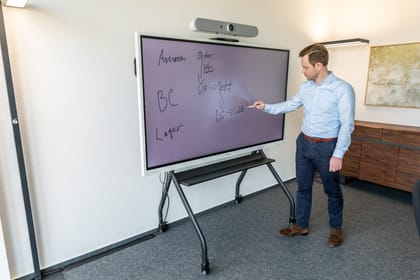
We work with clear commitments, a defined mirror team, and responsibilities staffed in writing. Anything that doesn't have to be decided under pressure moves a project forward faster than any additional workshop hour. Steering committee chair named from phase 2. Mirror team matrix in writing, not just in roles. Decision levels clear — who decides what, from when.
Visible Progress Instead of Long Radio Silence
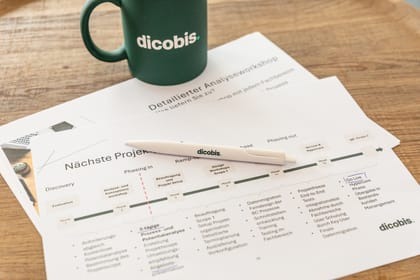
Weekly steering group with a fixed agenda and a status traffic light per workstream. Project status is visible, not hidden in the project manager's head. 30-minute steering group per week, same agenda. Central issue list instead of scattered email threads. Escalation runs through a defined format, not detours.

Stability Before Speed
Speed comes from stability — not from shortcuts. Cut-over with a plan B, hypercare as a project phase, fixed go-live date. Migration in three cuts instead of big bang. Hypercare on site and remote before service takes over. Handover to existing-customer management only at demonstrable stability.
Effort and Responsibility
Migration From Your Legacy System
Documented migration routines for more than ten typical source systems in three categories — specialized multichannel and retail ERPs, generic cloud ERPs, shop-centric setups. Master data in phase 3, transaction data at cut-over.
A Realistic View of Internal Effort
Customer-side project management: typically 30–50% over the project duration. Key users per department: significant load in workshop phases 3 and 4. IT leads: interfaces, migration, cut-over. Well-founded person-day indication after the phasing-in stage — not guessed.
Clear Decision Accountability
Who makes which decisions is fixed before the project starts — up to the steering committee for issues affecting the go-live date.
What You Get From Us, Guaranteed
The Four Commitments That Carry Every dicobis Project
Fixed Go-Live Date Before Any Configuration
Set in the contract before the first role is created in Business Central
Steering Committee Chair, Named
Staffed by name from phase 2 — on your side and ours
End-User Training by Your Key Users
A knowledge decision, not a cost-cutting decision
Hypercare Within the Project, Not in Service
Part of the project plan, not a downstream service contract
Lessons From Our Business Central Project Work
The Five Risks That Typically Sink ERP Projects
Scope Creep
Symptom: the wish list grows, the deadline wobbles.
How we address it: standard-first as the default, deviations must be justified, project freeze in phase 4
How we address it: standard-first as the default, deviations must be justified, project freeze in phase 4
Lack of Key-User Ownership
Symptom: end users are caught off guard at go-live.
How we address it: key users at the screen from workshop 1, end-user training delivered by key users
How we address it: key users at the screen from workshop 1, end-user training delivered by key users
Data Quality Gets Underestimated
Symptom: migration is delayed, old data corpses end up in Business Central.
How we address it: data quality gate in phase 1, migration in three cuts
How we address it: data quality gate in phase 1, migration in three cuts
Interfaces Become a Black Box
Symptom: go-live happens, but data doesn't flow cleanly.
How we address it: dicobis.connect with monitoring, retry logic, and audit trail
How we address it: dicobis.connect with monitoring, retry logic, and audit trail
Vague Project Status
Symptom: “We're almost done” — for three weeks straight.
How we address it: weekly steering group with a fixed agenda, status traffic lights, central issue list
How we address it: weekly steering group with a fixed agenda, status traffic lights, central issue list

Free Entry Point
Let's talk about your project before the project begins. A 25-minute methodology fit conversation, not a sales call. Afterwards, you'll know whether it makes sense to keep talking.
- Methodology fit against your starting position
- Legacy system, multichannel setup, interfaces
- Initial assessment of the critical risks in your project
- Indication of the realistic phase grid and key-user commitment
- Clear next steps — even if the conclusion is “not now”

FAQ
Questions IT Leaders Typically Ask
How quickly do we see initial improvements in daily work?
The first visible effects come in phase 3, as soon as key users work on the preconfigured industry standard in the workshops. In productive operations from month 9, the end-to-end process flows show their impact — no manual transfers between systems, one shared data state for sales, warehouse, and finance.
Which integrations are typically needed in logistics projects?
Typical in logistics settings: WMS, TMS, carrier connections, EDI interfaces to clients, customs systems, client ERPs. In e-commerce projects, additionally store and marketplace connections, fulfillment connectors, payment and accounting interfaces. All connections run via dicobis.connect.
Does this also work if we already run a predecessor ERP?
Yes. Documented migration routines for more than ten typical source systems in three categories — specialized multichannel and retail ERPs, generic cloud ERPs, shop-centric setups. Migration runs in three cuts: initial migration in phase 3, test migration as a dress rehearsal, final migration at cut-over.
How does the start work without endangering operations?
Standard-first and preconfigured prototypes reduce workshop effort and risk. A project freeze from phase 4 stabilizes things. End-to-end tests before acceptance, cut-over planned to the minute with a plan B. Hypercare as a project phase, not a service — we stay on it until the system demonstrably runs stably.
What distinguishes us from a classic ERP approach?
Standard-first instead of custom-by-default. Process prototypes instead of empty workshop slides. A fixed go-live date instead of a date corridor. Four commitments in place before the first configuration.