AI-First at Microsoft Directions North America 2026
In late April 2026, more than 1,400 attendees from 30 countries came together in Orlando to the Directions North America – the leading partner conference for Microsoft Dynamics 365 Business Central. dicobis Managing Directors Holger Lüke and Jonas Luge participated as well. One topic that spanned the entire event: AI, and the evolution of Business Central into a platform where agents carry out operational tasks on their own.
Business Central is evolving from an ERP system into a platform where AI agents increasingly take over operational tasks and execute business processes. Microsoft's message was clear: agents are no longer just another interface to the ERP. They're becoming part of the processes themselves and, at the same time, changing how Business Central solutions are built.
Moving from Copilot to Autonomous Business Processes
On stage, it became clear just how broadly Microsoft now thinks about the agent model. The two first-party agents, for automating incoming invoices and creating sales orders, are now available in every region where Business Central is offered. According to Microsoft, around 50% of customers have already tried at least one of them.
At the same time, Microsoft is expanding the agent ecosystem. Directions showcased a wide range of partner solutions – for time tracking, sales returns, inventory recall, maintenance intake, and more. A planned Expense Agent is set to automate the processing of expenses and receipts. The trajectory is unmistakable: from supporting individual work steps toward automating entire business processes.
What stayed with me most after Orlando: Microsoft is building trust directly into the product. Permissions, logs, a complete timeline, and agents you can actually trace. That's the difference between an AI feature and a production-ready system.”
Holger Lüke, Managing Director, dicobis
MCP: The Bridge Between Business Central and External Agents
A key building block here is the Business Central MCP server, which Microsoft released in 2026. It provides a standardized interface through which external AI agents can interact with Business Central. That turns Business Central not only into the place where its own agents work, but also into a platform that can open up to external agent systems.
Think of MCP as a standardized language between agent and application: through it, an agent can access defined Business Central data and functions without a completely custom interface for every single use case. Crucially, permissions and control over the available actions stay centralized. For production processes, that's essential. An agent shouldn't be able to make arbitrary changes in the ERP, only actions within clearly defined rules and with the appropriate access rights. That makes MCP a cornerstone of an increasingly agentic system landscape.
AI-First ERP: Deploying AI Where Business Processes Take Place
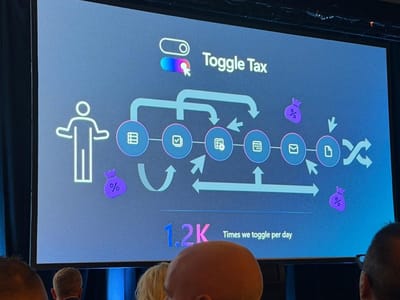
So what does this mean for companies? On a typical workday, employees switch between applications more than 1,200 times. A large share of those switches happens simply because information, processes, and tasks are scattered across different systems. Adding AI features as yet another set of tools alongside this fragmented landscape doesn't solve the underlying problem.
The AI-First approach starts somewhere else entirely: AI works where master data, transactional data, business logic, and permissions already come together: in the ERP. When an agent creates a sales order, processes an invoice, or checks a process, it operates within the company's existing data and rules.
Directions NA confirmed what we've been pursuing at dicobis for a while now: AI creates its value where the data is already cleanly structured. Anyone starting an ERP project today should set that course from the very beginning. AI-First means thinking about processes, data structures, and permissions from day one, so that agents can build on them.“
Jonas Luge, Managing Director, dicobis
Agents Are Changing How Business Central Itself Is Built
One of the conference's most far-reaching messages concerned the development of Business Central itself. Microsoft showed an increasingly agent-based development pipeline: agents can analyze and prioritize incoming requirements and issues, prepare tasks, and then support coding, reviews, and testing. A human, the product owner, stays in charge and signs off on the critical steps.
This also shifts the role of Business Central partners. As agents accelerate development cycles and take on parts of the classic development work, the emphasis moves from pure programming toward architecture, process design, quality assurance, governance, and orchestrating agents effectively.
What This Means for Business Central Users
More than 55,000 companies worldwide now run Business Central, and around 50% of them have already used at least one of the available agents. For businesses already using Business Central – or planning an implementation – the conference's message is unambiguous: agents inside the ERP system are not a future vision. The decisive factor for benefiting from them is the quality of the data and processes they work on. Starting an ERP project today doesn't just lay the foundation for the next five or ten years of your business processes; it also determines how well AI agents will be able to work with those processes down the line.