K5 Future Retail 2026: The Trends Shaping ERP in E-Commerce
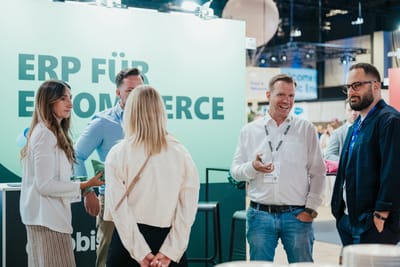
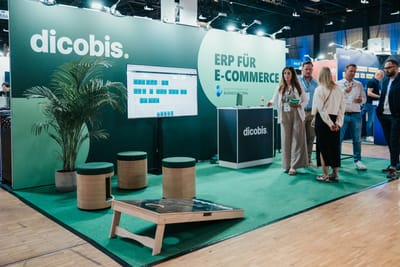
For more than a decade, K5 Future Retail has brought together the leading players in digital commerce. The annual conference in Berlin is one of the most important e-commerce events in the German-speaking market, where retailers, manufacturers, brands, and technology providers meet to discuss where the industry is heading. For the dicobis team, the in-depth conversations with e-commerce companies were the real highlight. Across more than 200 of them, four topics emerged repeatedly and together they point to a clear message: ERP has become the backbone of scalable e-commerce.
ERP as the Foundation for Sustainable E-Commerce Growth
Most e-commerce companies today share the same ambition: open new sales channels, expand into international markets, and connect with more retailers. That makes retailer integration one of the most pressing topics. Major retail partners like Edeka, Rossmann, and Müller open the door to significant growth, but they also come with strict requirements for product data, master data, and processes. Without a unified data structure, scaling turns into a bottleneck: product information has to be maintained in several places or reworked by hand to match each partner's specifications. A modern ERP system built for e-commerce solves this at the source. It allows for quick retailer onboarding and gives a growing business the flexible foundation it needs to add future sales channels without friction.
ERP and Logistics Are Converging
The tight connection between ERP and logistics was another recurring topic at K5. E-commerce companies described the same pain points: unreliable delivery times, messy inventory management, and incomplete shipping information. The usual culprit is missing real-time data between the ERP, the warehouse management system (WMS), 3PL providers, or shipping carriers. If stock is only synced once a day, or tracking numbers aren't cleanly tied to orders, the fallout is predictable – inaccurate inventory, unreliable delivery forecasts, and a support team buried in tickets. The conversations of the dicobis team at K5 outlined the importance of the ERP as the single source of truth. Real-time data and automated interfaces bring transparency to the entire supply chain and keep delivery processes reliable. For fast-growing online retailers especially, tight integration between ERP, logistics, and fulfillment is what makes scaling possible.
Data-Driven Inventory Planning Is Becoming Essential
Demand planning was another dominating topic in the conversations at K5. Peak events like Black Friday, seasonal swings, and last-minute marketing campaigns put enormous pressure on planning and traditional methods hit their limits fast. That's why more and more companies are shifting to data-driven forecasting. By pulling in sales figures, historical trends, seasonal patterns, and market changes, they can steer inventory far more precisely. dicobis.planning, for example, helps businesses anticipate demand early, optimize stock levels, and cut out-of-stock situations significantly.
AI Is Only as Good as Your ERP Data
No topic was more present at K5 than artificial intelligence, but the conversation has clearly matured: The focus is shifting away from individual AI use cases toward the quality of the data and processes behind them. Automated replenishment, intelligent forecasting, agentic AI – none of it delivers without consistent master data, clean processes, and up-to-date, real-time information. A modern ERP system is what makes that possible. Companies investing in data quality and standardized processes today aren't just fixing current problems; they're building the foundation for the AI applications of tomorrow.
The Takeaway: Future-Proof ERP Is Now a Competitive Advantage in E-Commerce
K5 Future Retail 2026 left little doubt: e-commerce is increasingly built on scalable processes, integrated systems, and high-quality data. Retailer integration, logistics, data-driven inventory planning, and AI are no longer separate initiatives. A modern e-commerce ERP brings them together on a single platform and creates transparency across every business process. With Microsoft Dynamics 365 Business Central, the industry-specific extension, and years of hands-on e-commerce expertise, dicobis helps companies build exactly that foundation – for ERP projects with a fast ROI and sustainable growth that's ready for whatever tomorrow's digital commerce demands. A big thank-you to every customer, partner, and visitor for the many inspiring conversations at K5 Future Retail 2026. We can't wait to turn these ideas into successful projects together.